
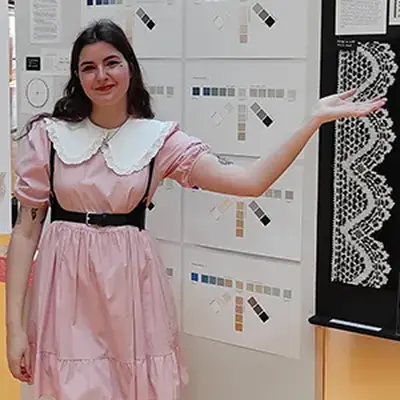
Joséphine Basso-Lacroix has been a student in the Department of Teaching and Research in Design (5DER) at ENS Paris-Saclay since 2018. In 2022, she completed a Master 2 in “Design Research” and, in 2023, she will travel to the Netherlands to complete a Pre-Doctoral Research Year Abroad (ARPE) at the TextielMuseum in Tilburg, where she worked in the trimmings and embroidery workshop. She also exhibited her work in this TextielMuseum workshop from March to June 2024.
ENS Paris-Saclay offers numerous opportunities in design, whether through partnerships with other schools, internship opportunities to further your projects, or the equipment available in the studios. Take the time to review the course outlines and proposed projects; if the academic content aligns with your interests and career goals, go for it!
Profile
What is your background?
I was admitted to the design department at ENS Paris-Saclay in 2018 after completing a preparatory program for the grandes écoles (CPGE). I completed the first part of my studies externally at the École des Beaux-Arts de Lyon in textile design, and then took a gap year to study at the Institut Supérieur Couleur Image Design at the University of Toulouse 2, where I earned a master’s degree in creative research in color.
In 2022, I joined the ENS campus to pursue the Master 2 in “Design Research,” and this year I am completing a Pre-Doctoral Research Year Abroad (ARPE) at the TextielMuseum in Tilburg, the Netherlands.
Did you know from the start what you wanted to do when you entered ENS Paris-Saclay? Did you want to pursue research from the very beginning of your studies?
When I took the entrance exam for ENS Paris-Saclay, I knew I wanted to pursue textile design. The opportunity to complete my program as an external student was a blessing; it gave me access to high-quality hands-on training and allowed me to learn from experts in the field.
Research gradually became a part of my studies and my work, as a logical progression of my learning. It was through my practical work that questions emerged which are now at the heart of my research.
You’re participating in the pre-doctoral research year abroad (ARPE). Why did you choose this path, and what does your internship at the Textiel Museum in Tilburg entail?
I chose to do the ARPE this year because I plan to begin my dissertation at the start of the next academic year, and this program provides an ideal framework for refining my research topic and assembling my advisory team. In addition, I’ve long wanted to spend part of my studies abroad to expose myself to other creative and research methodologies.
The TextielMuseum is an innovative space because it serves as both a museum and a textile experimentation lab, the TextielLab. I work in the trimmings and embroidery workshop. My role is to introduce the public to the techniques of these disciplines by conducting demonstrations and creating pieces that illustrate the potential of these techniques. This allows me to introduce the public to little-known skills while simultaneously developing innovative pieces.
Could you please describe your current projects?
The technique at the heart of my practice is bobbin lace. My current projects therefore aim to build bridges between lace-making techniques and the passementerie and embroidery techniques developed at TextielLab. This allows me to bring to life samples and textile pieces that incorporate a variety of traditional skills that are in danger of disappearing.
I hope to help people rediscover these skills and explore their potential for contemporary textile design. The work I create is primarily intended for garment embellishment and interior decoration.
You are currently exhibiting at the Textiel Museum in Tilburg. Can you tell us more about that?
Some of the research I’ve conducted in the TextielLab workshops is on display in the museum’s trimmings section until the end of my ARPE. I’m honored to have the opportunity to show the public the results of my work and to raise awareness about bobbin lace.
This exhibition is an evolving one, as I’m adding new samples as I go, which allows me to showcase research that’s still in progress and demonstrate the dynamism of the Lab, which encourages young designers to take advantage of the workshop tools.

What are your plans for the future?
Lace has been at the center of my academic work since 2020, and I hope to continue this effort to revitalize our cultural heritage as part of a broader academic research project. The three years of doctoral study would allow me to pursue this ambition and to document my research in writing, giving it an institutional framework. It would also enable me to contribute to the development of scholarly literature on textiles and bobbin lace, which is still lacking today.
After completing my Ph.D., I plan to become a researcher and textile designer. By focusing my research on such a niche craft, I believe it is essential to pursue a dual career that involves popularizing scientific knowledge and leading workshops at conferences, art schools, or museums; and at the same time, to integrate my research into a professional context related to textile production, by collaborating with fashion houses or historical reenactment workshops, for example. This role as a designer-researcher would allow me to demonstrate the vitality and relevance of the expertise I possess, in both scientific and entrepreneurial contexts.
Can you tell us what the School has offered you?
I’ve been a student at the École Normale since 2018, and ENS Paris-Saclay has allowed me to go exactly where my projects have led me, to discover very different environments, to meet passionate and fascinating specialists, and above all, to build a tailor-made path for myself. I’m very grateful for the opportunity to study under the best conditions, alongside experts who are helping me develop expertise in textiles. I don’t think any other school would have given me this freedom.
What advice would you give to design students who are hesitant about coming to ENS Paris-Saclay?
ENS Paris-Saclay offers numerous opportunities in design, whether through partnerships with other schools, opportunities to do internships to further your projects, or the equipment available in the workshops. Take the time to review the course outlines and proposed projects; if the academic content aligns with your interests and career aspirations, go for it!
Universities that prioritize research projects through design practice are still rare in France.