
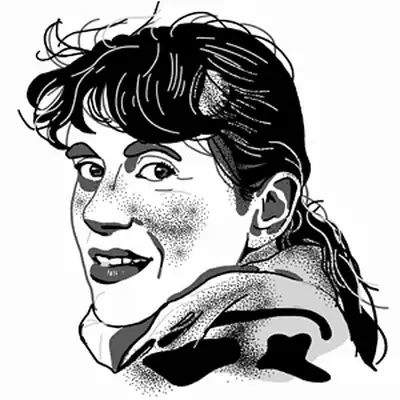
Visual artist
- More than 50 exhibitions, installations, and site-specific projects in Europe and Canada
- 5 permanent installations created as part of public and private commissions.
- Monograph Rhizome Cupules Eclosion (112 pp.), text by Paul Ardenne, bilingual, (Presses du Réel, 2022)
Its Activities
Christine Maigne is a visual artist and also a professor at Ensaama Olivier de Serres, one of the four major Parisian design schools under the French Ministry of Education.
- Today—Visual artist and professor at Ensaama Olivier de Serres
- 1989 - Agrégation in Visual Arts
- 1987–1990 - Bachelor’s and Master’s degrees in Applied Arts, DEA (Master 2) in Visual Arts at Paris 1 Saint Charles
- 1986 - Admitted to ENS Cachan—Art and Industrial Design Department
“My work as an artist involves moments of solitary concentration in my studio, of course, but just as much collaboration and interaction with other professionals as part of my projects. It also involves designing works for public commissions, as well as exchanges with other artists in France and abroad, through joint exhibitions or other projects.
I have always taught alongside my career as an artist, with the exception of periods of leave and annual stays in Canada and then in the United States. As part of my teaching work—which I currently do part-time by choice—I teach visual arts research courses for 4th- and 5th-year students (Diplôme supérieur des arts appliqués, DSAA). »
Ensuring the Representation of Women Artists
One might think that discrimination is less prevalent in the art world than in more conventional professional settings, but it exists in a more insidious way. The most obvious example is that when studies are conducted on the presence of works by women artists in major exhibitions, museums, or collections, a clear underrepresentation is evident (see statistics presented by the Guerrilla Girls in the 1980s). I’m part of a think tank of women artists where we discuss and analyze these issues, which have been coming to the forefront again in recent years.
As in all fields, motherhood marks a critical turning point, but in a more distinctive way within the art world, since a significant number of women choose not to have children. The artist Marina Abramović sparked a debate on this topic in a 2016 interview, in which she asserted her decision to forgo motherhood as a female artist and presented it as a necessity that extends beyond her personal circumstances. For my part, I had children at a younger age than most women artists, but I admit that I sometimes chose to keep it to myself—or at least not to mention it—when my children were young, because I felt it wouldn’t work in my favor. Some people, upon learning of my first pregnancy, almost saw it as a form of giving up. Having more than one child elicited such astonishment in others that they couldn’t imagine I could juggle everything. However, the rise of feminism in recent years has allowed female artists to truly engage with these issues. For example, in 2020, the L’Aha art center (Paris) presented an exhibition and symposium by female artists titled “[Re]production: Thinking About Motherhood in Contemporary Art.” I myself recently developed a body of work on motherhood based on photographs I took documenting experiences during my last pregnancy, which took place 20 years ago. I chose to show this work in an exhibition featuring only female artists (“La tangente,” Villefranche de Rouegues, 2023). It was then that I realized I had crossed a threshold by making this choice; I can’t say whether it’s a matter of age or the times we live in—after all, it’s easier to say you have children once they’re old enough that you no longer need to care for them...
Even if this kind of approach may seem artificial—and fundamentally, it’s the work itself that matters—I think that mandating gender parity in major exhibitions, or at least ensuring greater representation of women, has significantly changed things in recent years. Initiatives like the Aware Prize, dedicated exclusively to women, highlight this need to restore balance.
- In 2018, the “Women House” exhibition at the Monnaie de Paris addressed feminist issues under the curatorship of Camille Morineau.
- Perhaps somewhat aware of this issue, major institutions occasionally undertake one-off initiatives: the display of the permanent collections at the Centre Georges Pompidou, titled “elles” and entirely dedicated to women artists, marked a milestone in 2009.
- The MoMA followed suit in 2010 with “Modern Women: Women Artists at the MoMA.”
- But London’s Tate Modern has a far more exemplary approach in this regard, as it has established a permanent policy thanks to former director Frances Morris, who spent years working to highlight women artists in the collections.
Illustration credit: Jérôme Foubert
Discrimination persists in the art world, at various levels. I take part in discussions and exchanges with female artists on these complex issues. The rise of feminism in recent years has brought these topics to the forefront. Motherhood is a challenge, particularly in this field, where some choose not to have children. In the past, I sometimes kept my status as a mother to myself, feeling that it might have put me at a disadvantage...